As the international order fragments, confidence in the durability of democratic alliances is increasingly tested—not only by external adversaries, but by the capacity of democracies to withstand erosion from within. Western policymakers now debate the resilience of the transatlantic bond, the credibility of democratic partnerships, and whether liberal systems can absorb sustained pressure without hollowing out. Georgia offers one of the clearest—and most uncomfortable—answers. Not because it was weak, divided, or ambivalent about its place in the transatlantic community, but precisely because it was none of those things. Georgia had an unambiguous Western orientation, a record of democratic reform that once inspired its neighbours, and a proven willingness to absorb real political and security costs in pursuit of partnership with Europe and the United States. Yet over the course of a decade, it was allowed to slide back into Russia’s orbit through state capture, informal rule, and democratic hollowing—largely overlooked, persistently rationalised, and gradually normalised by Western governments and policy institutions entrusted with defending the rules-based order.
This erosion did not occur in silence. It unfolded against a backdrop of persistent and increasingly urgent warnings from within Georgia itself. From the early years of Georgian Dream’s rule, ordinary citizens, independent journalists, and opposition leaders sounded the alarm that Georgia had ceased to be a democratic success story. What was widely branded in Western capitals as a model electoral transition in 2012—the peaceful transfer of power from the United National Movement to Georgian Dream—was not itself the problem. The danger lay in what followed. That transition marked the beginning of a gradual but systematic democratic regression: the consolidation of informal power, the erosion of institutional independence, and a strategic reorientation toward Russia unfolding beneath the veneer of formal institutional benchmarks and procedural compliance.
Yet the “success story” label proved remarkably durable. It became a self-fulfilling truth—repeated often enough to substitute for scrutiny. Believing in it was convenient. It required little political capital at a moment when Western attention was absorbed by larger crises and when limiting friction with Russia was widely viewed as preferable to opening another contested front. Georgia, already partially occupied by Russian forces, was treated less as an unresolved security challenge than as a problem best kept “stable.” Georgian Dream’s own messaging reinforced this logic. Its leadership openly framed accommodation with Moscow as pragmatism, insisting that Georgia should not be a “controversial issue” between the West and Russia—an argument readily accepted despite Russia’s ongoing occupation of Georgian territory and its complete absence ofconstructive engagement with the West. In effect, Georgia’s proclaimed “pragmatism” made it easier to downplay both the moral stakes and the strategic consequences of accommodating Russia.
Warnings about where this trajectory was leading were explicit. Georgian observers pointed to the deliberate dismantling of the country’s state security architecture after 2012. Counterintelligence capacities that had once targeted Russian operatives were hollowed out; security services were repurposed into instruments of political control. Courts were captured, prosecutions politicised, independent media systematically pressured, informal governance entrenched, and democratic institutions steadily hollowed from within. The insistence that Georgia remained the “frontrunner of the Eastern Partnership” was no longer merely inaccurate—it was actively dangerous.
Even after 2014, when Russia annexed Crimea and made unmistakably clear that it was escalating—rather than moderating—its confrontation with the West, the implications for countries like Georgia continued to be minimised. What went largely unexamined was not Moscow’s intent, but its changing methods. Russia was no longer relying primarily on overt military force, energy blackmail, or economic embargoes to reassert control. Instead, it diversified its strategy, pursuing internal takeover through state capture, informal power, and political manipulation. This shift was visible, documented, and repeatedly flagged by local actors, yet it aligned too neatly with Western preferences not to disrupt fragile efforts to manage relations with Russia. Moscow had not abandoned its objective of reclaiming countries like Georgia; it had refined the means. The warnings were there—detailed, consistent, and grounded in evidence. What was missing was not information, but the willingness to confront what it implied.
It took Russia’s full-scale invasion of Ukraine in February 2022 for the language to change. Terms such as “Russian influence,” “state capture,” and “hybrid authoritarianism” suddenly entered the mainstream of Western analysis, treated as self-evident truths—as if they described a recent deviation rather than the endpoint of a long and visible trajectory. For Georgians, there was no sudden awakening. There was continuity. What changed was not the reality on the ground, but the cost of ignoring it. But belated recognition did not produce a corresponding reassessment of who had shaped Western understanding of Georgia—or why.
This raises an uncomfortable question for Western policymakers: why do so many of the voices, organisations, and intermediaries that minimised Georgia’s democratic collapse before 2022 continue to dominate policy platforms, funding streams, and advisory spaces today?
Western engagement had long prioritised access and manageability over accountability and truth. This did not simply misread Georgia—it actively reshaped it. By validating superficial reforms while ignoring informal power, by funding “trusted partners” whoechoed official narratives, and by rewarding technocratic performance over democratic substance, Western policy helped normalise a system in which elections existed without real choice, courts without justice, and institutions without autonomy.
Over time, an entire ecosystem—consultancies, NGOs, policy shops, diplomatic routines, and monitoring frameworks—was built around a narrower but powerful narrative: that Georgia’s peaceful electoral transfer of power in 2012 marked a democratic breakthrough, and that the emergence of a coalition government signalled a transition toward a more pluralistic political system. Careers were made on this assumption. Programs were funded around it. Reports were written to reinforce it. When Georgians challenged this narrative, they did not merely challenge a government; they challenged institutional reputations and professional capital invested in that interpretation. Their warnings were reframed as “polarisation.” Their evidence was dismissed as “anecdotal.” Their protests were reduced to “domestic political infighting.”
Today, many of the same actors seek to rewrite history, presenting Bidzina Ivanishvili’s open alignment with Russian interests as a shocking reversal rather than the logical exposure of what had long been in place. This reframing is not benign. It launders responsibility and allows failed approaches to persist under new rhetoric.
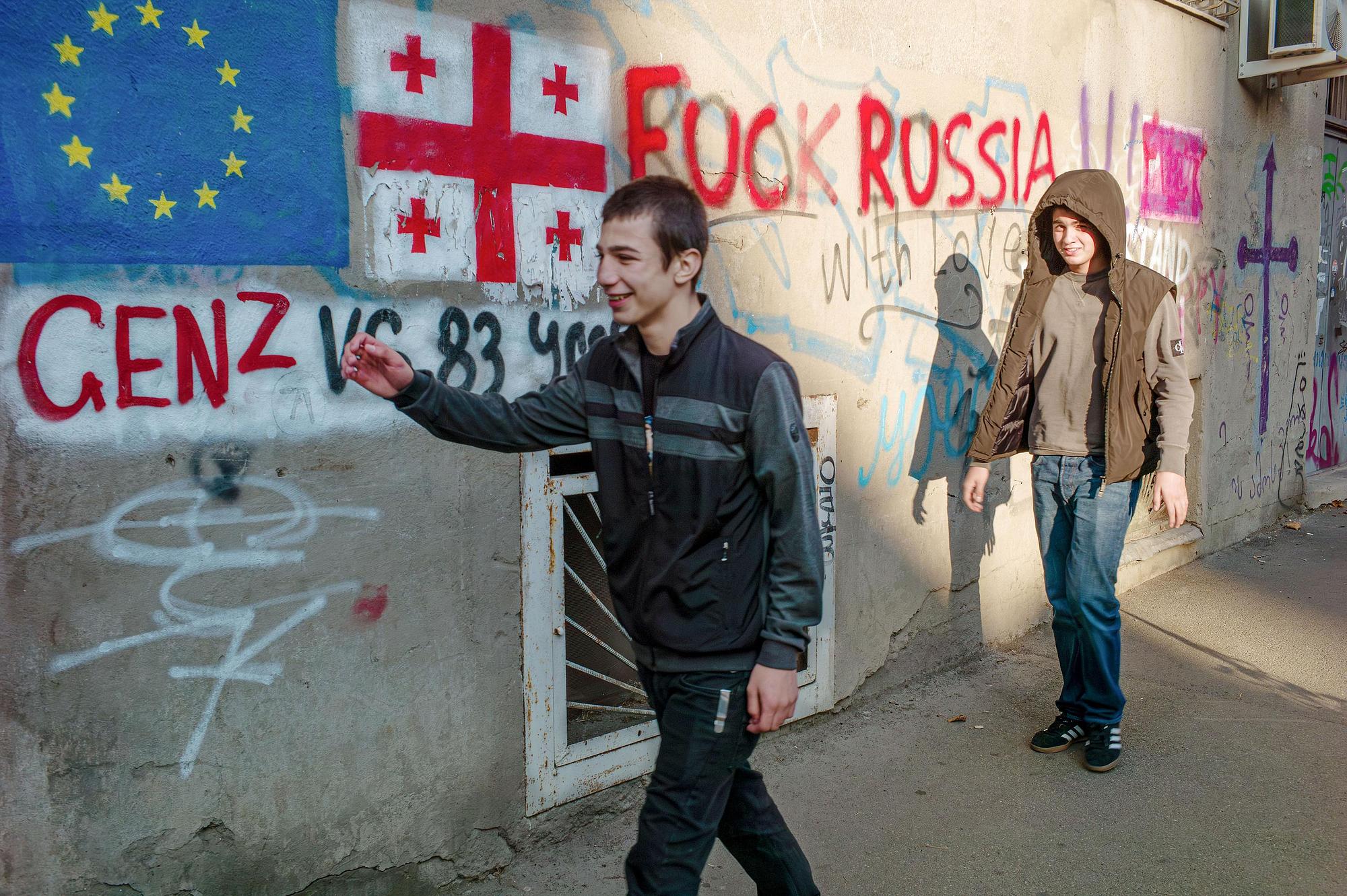
Meanwhile, the consequences are borne by Georgians: journalists beaten in the streets, activists prosecuted, civil society stifled, opposition politicians jailed, and voters watching their country pulled back under Russia’s influence at accelerating speed. Yet despite mounting repression, large segments of Georgian society continue to resist democratic erosion—evidence not of inevitability, but of how much was lost through earlier inaction.
Let us be clear: Georgian Dream did not “change course.” It is fulfilling its mandate. The only thing that changed is that Russia’s war against Ukraine made the cost of pretending too high to ignore.
For European and American policymakers, the lesson is not simply that Russia exerts malign influence. It is that the strength and resilience of Western alliances depend as much on how democracies respond to erosion within their own partnerships as on how they deter threats from outside. Georgia’s experience is not a regional anomaly. It is a warning about how democratic backsliding unfolds in plain sight when stability is mistaken for resilience and formal compliance is allowed to substitute for democratic substance.
As Western governments reassess alliance credibility, strategic cohesion, and democratic endurance in an era of sustained pressure, Georgia’s case deserves renewed attention—not as a failure consigned to the past, but as a test of whether the West can learn in time. A country that once demonstrated the possibility of democratic transformation was not lost through invasion or popular rejection of the West, but through a gradualaccommodation of state capture that hollowed out institutions while preserving appearances.
Helping Georgians reclaim their democracy is therefore not an act of charity or regional goodwill. It is part of the same struggle now shaping the future of the transatlantic community: whether democratic alliances can recognise internal decay early, correct course before capture becomes irreversible, and align strategic ambition with democratic reality. The answer will determine not only Georgia’s future, but the resilience, endurance, and competitiveness of democratic alliances in an era of sustained pressure.
Eka Tkeshelashvili is a former Minister of Foreign Affairs of Georgia.
Zaza Bibilashvili is the Chairman of the Chavchavadze Center for European Studies and Civic Education.
Disclaimer
This publication receives funding from the European Parliament. The authors of this paper are not financed by the European Parliament.
© 2026 Wilfried Martens Centre for European Studies
The European Parliament and the Wilfried Martens Centre for European Studies assume no responsibility for facts or opinions expressed in this publication or their subsequent use. Sole responsibility lies with the author of this publication.
https://www.martenscentre.eu/wp-content/uploads/2026/04/Georgia-Paper.pdf
https://www.martenscentre.eu/publication/the-case-of-georgia-and-lessons-for-the-west/