Back in 2022, the EU still held Georgia up as a democratic success story among the Eastern Partnership countries. Fast forward to today, and the picture couldn't be more different. The country holds what opposition groups describe as more than 150 political prisoners. Its elections are rigged. Its ruling party keeps power through violence and intimidation. Western observers talk about all this as though it came out of nowhere. It didn't.
Georgian Dream and its founder, the oligarch Bidzina Ivanishvili, have been taking apart Georgia's democracy piece by piece since the moment they came to power. The warning signs were always there – for anyone paying attention.
It took GD just four months after winning the 2012 elections to show what it was really about. Violent protesters attacked opposition politicians outside the National Library to stop President Saakashvili from delivering his annual address.[1] They were fined next to nothing and let go.[2] Parliament, meanwhile, had already blocked the president’s speech from happening in its own chambers.[3] A minor episode, sure. But it set the pattern for everything that followed.
What emerged over the next few years was a remarkably consistent playbook, built on three pillars. GD encouraged aggression against opponents while making sure the attackers faced no real consequences – In a 2016 by-election, party-affiliated athletes beat opposition figures right outside a polling station in Kortskheli and got off with bail and minor charges.[4] [5] At the same time, the party turned the justice system into a weapon, launching politically motivated prosecutions that sent opponents to prison or drove them into exile – Including former president Saakashvili himself. And then there was the media. GD facilitated a court-driven ownership transfer of Rustavi 2, the country's most-watched opposition broadcaster.[6] That channel now pumps out regime propaganda. Together, these tactics amounted to a systematic dehumanization campaign – one that would pay off handsomely when GD needed to turn the entire country against anyone who challenged its rule. The impunity wasn't accidental. It reflected something deeper: GD's steady, quiet takeover of law enforcement and the judiciary – a process that was already well advanced by its second term, even if Western partners preferred not to see it.
All of this happened while GD kept up the appearance of a functioning democracy – a textbook case of what political scientists call electoral authoritarianism. After the 2016 elections – which international observers assessed as competitive and well-administered, but flagged for misuse of administrative resources, and incidents of violence – GD secured a constitutional supermajority. The opposition raised serious concerns about the fairness of the process, but those concerns never gained real traction with Western partners. With that majority in hand, what remained of institutional checks began to crumble.
The apparent turning point came in 2018. GD supported presidential candidate, Salome Zurabishvili, couldn't seal the victory in the first round. That was the moment the party's leadership seemed to grasp that even the pretence of democratic competition was becoming a liability. What happened next tells you everything. The regime's favourite broadcaster announced “special programming” designed to stop the opposition from winning. Political polarization was cranked up to new extremes. And days before the runoff, Ivanishvili's Cartu Foundation announced it would write off the debts of 600,000 citizens – a move that Georgian and international watchdog organizations widely condemned as voter bribery on a staggering scale. International observers noted that the debt relief initiative, along with the involvement of senior state officials in the campaign, further blurred the line between party and state. Once again, the opposition cried foul. Once again, the West took note but took no meaningful action.
After 2018, GD stopped bothering with subtlety. Having spent years successfully branding the former ruling party as a national enemy, the regime started pinning that same label on anyone who pushed back – other opposition parties, NGOs, independent journalists, even GD's own former prime minister. Regime-controlled outlets locked out every dissenting voice. Public debate, the thing that keeps any democracy breathing, was suffocated.
Law enforcement, by now thoroughly under the party's control, became just another campaign tool. Ahead of the 2020 elections, GD arrested two cartographers – former members of the state border delimitation commission – and charged them with attempting to violate Georgia's territorial integrity by allegedly using flawed maps in border negotiations with Azerbaijan.[7] The regime used the case to promote a conspiracy theory: that the opposition, when in power, had tried to hand Georgian land to a neighbouring country. Fifteen NGOs, including Transparency International Georgia, publicly denounced the prosecution as politically motivated.[8] Once the votes were counted and GD had its victory, the urgency evaporated. The defendants were quietly released on bail, and the case – so loudly trumpeted weeks earlier – faded from the regime's messaging.
In 2023, when mass protests forced GD to withdraw the foreign agents' law, the West breathed a sigh of relief. Democracy, it seemed, had held. A year later, GD came back with the same law – only this time prepared to push it through no matter the cost. The protests were bigger. The crackdown was harder. What followed was not a single repressive act but an avalanche: law after law dismantling civic freedoms, scores of political prisoners, independent media forced off the air. This was not a regime lurching toward authoritarianism. This was one that had been walking steadily in that direction for over a decade – and had finally decided to stop pretending it wasn't.
The West's failure wasn't a failure of prediction. It was a failure of response. Every unpunished beating outside a polling station, every court bent to political will, every silenced broadcaster, every opposition alarm dismissed as sour grapes – these were all signals. And every time, the response was a statement of concern, never a consequence.
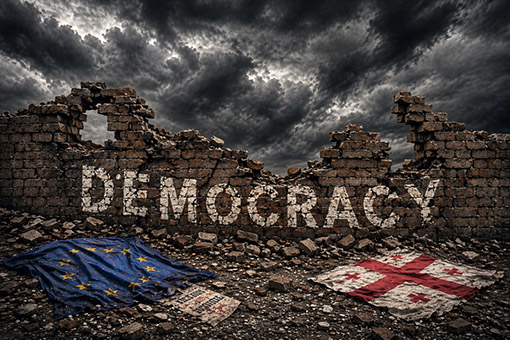
Georgia's democracy wasn't destroyed in a single blow. It was taken apart methodically, brick by brick, over the course of twelve years, in full view of its supposed allies. The only real question left is whether the West will keep acting surprised – or finally treat this for what it's always been: a deliberate, calculated dismantling that demands an answer, not just acknowledgement.
[1] https://icds.ee/en/turmoil-in-tbilisi-georgias-dream-imperiled/
[2] https://civil.ge/archives/122595
[3] https://old.civil.ge/eng/article.php?id=25726
[4] https://old.civil.ge/eng/article.php?id=29168
[5] chrome-extension://efaidnbmnnnibpcajpcglclefindmkaj/https://gyla.ge/files/banners/Elections%20Newsetter%203,%202018.pdf
[6] https://transparency.ge/en/post/general-announcement/statement-regarding-case-rustavi-2-tv-station
[7] https://civil.ge/archives/394791
[8] https://transparency.ge/en/post/cartographers-case-politically-motivated-investigation